
What Is BioGeometry?
Most of us have walked into a room and immediately felt “off” — without being able to say why. Or stepped outside after a long stretch indoors and felt noticeably lighter. You couldn’t see it, hear it, or smell it, but you felt it. That’s the territory BioGeometry works in: subtle energy, the kind that’s real enough to affect how we feel, even though it doesn’t show up on a bathroom scale or a thermometer.
BioGeometry is a system developed in the 1970s and ’80s by Dr. Ibrahim Karim, an Egyptian architect who noticed something curious while studying ancient temples, sacred sites, and Gothic cathedrals: certain proportions, angles, and shapes seemed to consistently produce a calming, balancing effect on the people, animals, and plants around them — while other shapes and environments seemed to drain or unsettle them. He spent decades turning that observation into a structured practice for detecting and correcting these subtle energy qualities in homes, workplaces, and the body itself.
Geopathic Stress: The Invisible Drain
A lot of what BioGeometry practitioners look for is called geopathic stress — patterns of energetic disturbance that quietly tax a living system over time. It comes from two main sources:
- Natural sources — crossings in the earth’s energy grids, underground water veins, and fault lines. Long before anyone had a name for it, people noticed that trees growing over these spots often look stunted, crooked, or oddly bulged compared to their neighbors a few feet away.
- Man-made sources — what’s often called “electrical pollution” or “electrosmog”: dirty wiring, electromagnetic fields from appliances and wireless devices, and the general buzz of modern electrical infrastructure.
Neither type is dramatic on its own. The effect is usually more like a slow leak than a flood — low-grade fatigue, restlessness, or a sense that a particular room or spot in your home never quite feels restful, no matter how nicely it’s decorated.
How It’s Detected: Two Very Different Tools
Here’s where BioGeometry gets a bit nuanced, and it’s worth understanding the distinction because it’s central to how a practitioner actually works.
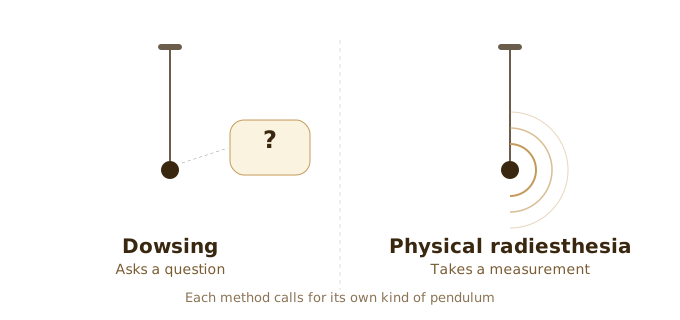
You may have heard of dowsing — using a pendulum or rod to ask a question and watch for an answer, almost like a conversation with your own subconscious. Dowsing is real and has its place, but it isn’t what BioGeometry practitioners use for this work.
BioGeometry uses physical radiesthesia instead (sometimes called French or micro-vibrational radiesthesia). The difference comes down to this:
Dowsing asks a question.
Physical radiesthesia takes a measurement.
Think of it this way: dowsing is like asking someone “does it hurt here?” — there’s a question, a dialogue, an answer shaped by intent. Physical radiesthesia is more like holding up a tuning fork. A tuning fork doesn’t ask the room anything. It simply vibrates in resonance with whatever sound is already present and shows you, plainly, what’s there. No dialogue, no interpretation — just a reading.
That’s the role a calibrated pendulum plays in BioGeometry. The practitioner’s body and the pendulum become a kind of instrument, tuned to register specific subtle energy qualities — the same way a tuning fork is tuned to a specific note. Hold it near a person, an object, or a spot in a room, and it shows what’s resonating there, nothing more, nothing less.
How It’s Corrected
Once an area of geopathic stress or energetic depletion is found, BioGeometry offers several ways to bring it back into balance — through specific shapes, colors, numbers, and BioSignatures: precise linear patterns designed to mirror the natural energy pathways of the body and the environment, restoring a more harmonious flow where it’s been disrupted. Dr. Karim also designed specialized tools and attachments calibrated specifically for this purpose.
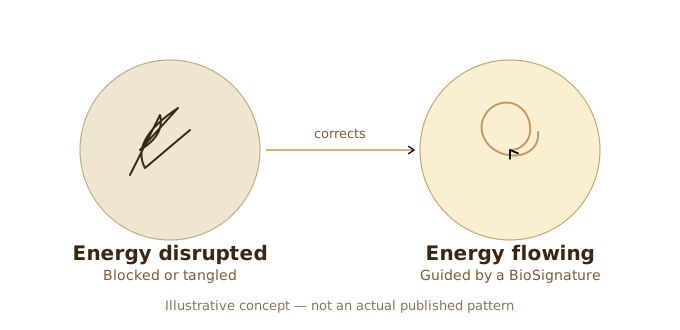
The goal in every case is the same: not to fight or cancel the disturbance, but to introduce a quality of energy that brings the system back toward a natural, centered balance — the same quality Dr. Karim found radiating from sacred sites and ancient temples in his original research.
Real-World Recognition
BioGeometry has had some notable real-world applications. In the early 2000s, Dr. Karim was commissioned — first by residents and a Swiss telecommunications mediation body in the village of Hemberg, and later by local government in Hirschberg — to apply BioGeometry corrections in areas where people reported symptoms of electro-sensitivity near mobile phone antennas. Swiss national television documented both projects, and residents and local officials reported a marked improvement in how people felt and in the surrounding ecology. It’s worth noting these are documented case studies and media coverage rather than independent peer-reviewed clinical trials — but they remain a meaningful, real-world track record for a system that’s still relatively unknown outside Europe and Egypt.
Why I Work With It
As a Sound Practitioner, I’m already working in the realm of vibration and resonance every day. BioGeometry gives me another lens — and another set of tools — for noticing where a person’s energy field, or the space they live and work in, may be quietly weighed down by something outside the body itself. Curious how that actually plays out in a session? Here’s how I bring BioGeometry into my Biofield Tuning practice →